One 30-Minute Recording, Two Weeks of Content, and the One Piece That Actually Closes Deals
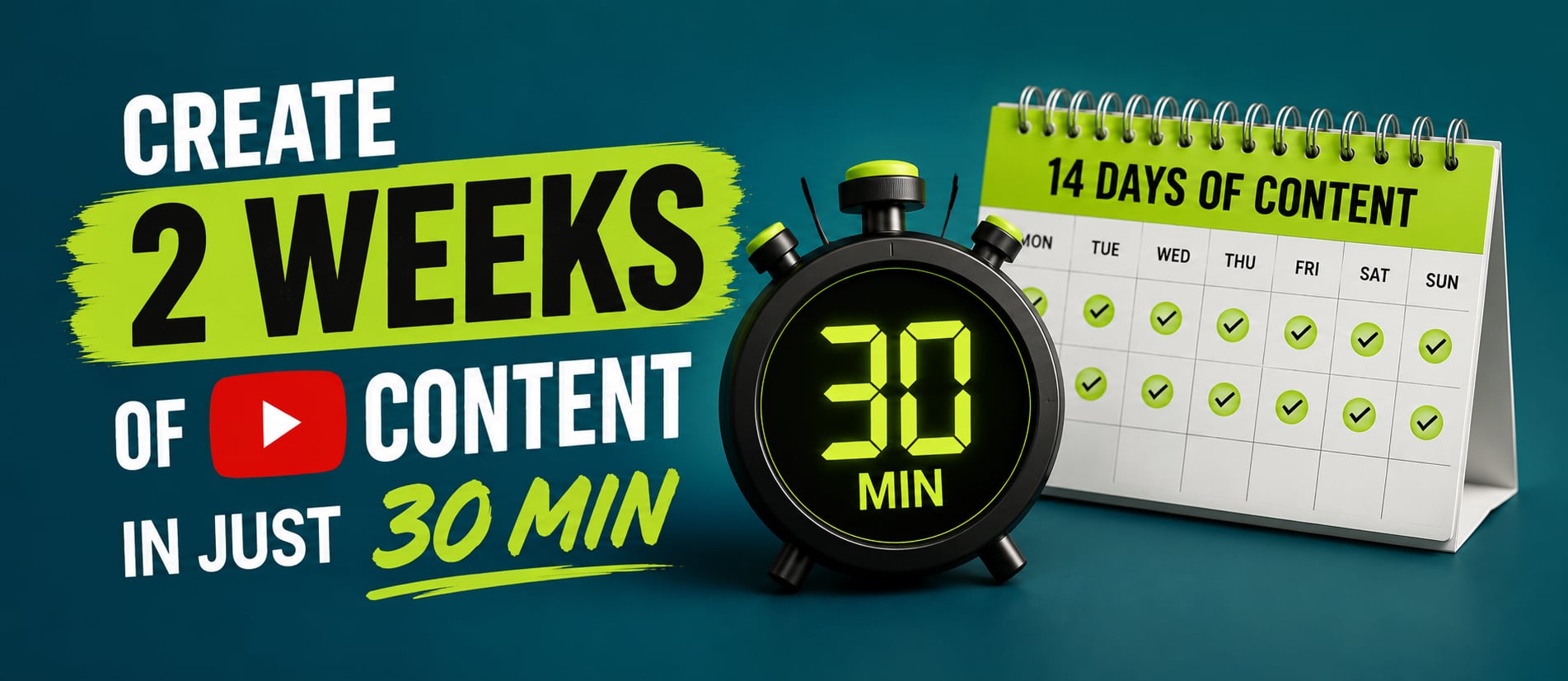
Most B2B founders who try content marketing burn out within three months.
Not because they hate the camera. Not because they're lazy. Because they're running it on willpower: sitting down every day to invent something from scratch, staring at a blank page, trying to think up something worth saying.
Nobody can keep that up while also running a business.
But here's the thing: you don't need to create more content. You need to get more out of what you already know.
I run a YouTube channel with around 7,300 subscribers. Not viral. Not trending. Somehow it's generated over half a million dollars in courses, consulting, and contracts. Every one of those clients found me on their own, trusted me before we ever spoke, and showed up to the first call basically already decided.
The whole thing runs on about 30 minutes of camera time a week.
Here's the exact system behind that.
If you want the video version of this post, check it out here:
Quick Takeaways
- One 30-minute recording produces two long-form videos, six short clips, ten-plus social posts, a newsletter, a blog post, and the sales asset that actually converts
- Four of the five output types get you attention. One gets you paid. Almost every founder skips that one
- The system runs on a process, not willpower, so it survives the week your motivation is gone
- Extracting from one recording keeps your content sounding like you, not like a ghostwriter guessing at your voice
- The goal was never more content. The goal is a pipeline that doesn't live and die on referrals and cold outreach
Why Most Content Systems Break Down
The problem with "create content consistently" as advice is that it assumes you have infinite creative energy on top of everything else you're doing.
You sit down to write a post. An hour later you've got a draft you're not happy with. You force through a recording. You try to do it again next week. And then something at work blows up and the content is the first thing that goes.
Three months later you've published four things and quietly stopped.
The fix isn't better discipline. It's a different model. Instead of creating from scratch, you extract. You record what you already know once, and everything after that is just you pulling content out of what's already there.
One session. Everything else is processing.
The Five Outputs From One Recording
Say you've just finished 30 minutes on camera, talking through one topic you know well. Here's what that single session produces.
Output 1: The Long-Form Video (and a LinkedIn Version)
This is the anchor, and it's the only thing you actually have to record. Take those 30 minutes, cut them down to a tight 8 to 12 minutes, strip the filler, keep the substance, and it goes up on YouTube. A version goes on LinkedIn too.
One recording. Two long-form pieces. That's already more than most founders publish in a month.
Output 2: Short Clips
Inside that long video, there are already three to six moments that work on their own: a sharp point, a quick story, a contrarian take, a specific number. Pull them out, cut them vertical and horizontal, add captions, and you've got your Shorts, your LinkedIn videos, and your Reels.
These are your reach engine. They go out and find strangers and warm them up. But a stranger finding you is not the same as a stranger paying you, so keep reading.
Output 3: Social Posts
Now you're off video entirely. A story from the recording becomes a story post. A framework becomes a carousel. An opinion becomes a thought-leadership post. From one 30-minute session, you can pull ten or more posts and schedule them across the following two weeks.
This is how you stay visible everywhere your buyers are looking, without having to sit down and think of something new every morning.
Output 4: Newsletter and Blog Post
The same script becomes an email and an article. Both matter, but the email list is probably the most valuable piece of distribution in the whole thing. The algorithm can change overnight. Your list is the one audience you own.
Output 5: Sales Assets
Here's the one almost nobody makes. And it's the only one that actually touches the deal.
That framework you explained on camera becomes a PDF, or a calculator, or a mini-tool. A case study you mentioned becomes something you send a prospect right before or right after a call. The same recording that pulls people into your funnel is now also helping you close them at the bottom of it.
This is the one that gets you paid.
It's also the most boring to make. You can't post it and watch the engagement roll in. It doesn't feel like content creation. It just quietly does the work of converting the people who were already interested.
What One Month Actually Looks Like
Add it all up. One 30-minute recording becomes:
- Two long-form videos (YouTube and LinkedIn)
- Six short clips (Shorts, LinkedIn, Reels)
- Ten-plus social posts scheduled across two weeks
- One blog post and one newsletter email
- The sales assets that convert leads into clients
Do this twice a month and you're working with one hour of camera time total, for a full month of distribution across every channel your buyers use.
That's not a content strategy. That's a pipeline system.
Why Extracting Beats Inventing From Scratch
It runs on a process instead of willpower. You never stare at a blank page. You never try to invent a topic from scratch. You show up, record what you already know, and the system handles the rest. It survives the week your motivation is gone, because your motivation was never the thing keeping it running.
It actually sounds like you. Because it came from you talking, not from someone trying to write in your voice and hoping it comes across. When a buyer is deciding whether to trust you, authenticity is basically the whole game. You cannot fake your way through that.
It keeps you in your lane. You're not slowly turning into a video editor or a social media manager. You're doing the one thing you already do better than anyone, which is talk about your own work. The system processes that into content. You don't have to become a creator to run like one.
The Real Payoff of the System
Here's what this actually builds if you stick with it.
Someone stumbles on one of your short clips. It sends them to a long video. They read a few of your posts. They join your email list. They get the case study or the tool you sent. And by the time they book a call, they've already decided you're the person who can solve their problem.
When you get on that call, you're not selling. You're confirming.
That's a completely different conversation. No credibility-building in the first fifteen minutes. No skepticism to overcome. No "let me think about it." They came to you. They already trust you. The call is just formalities.
That's the real payoff: a pipeline that isn't living and dying on referrals and cold outreach, where trust is already built before the first conversation, and where you're the obvious choice instead of watching a more-visible competitor walk off with deals that should have been yours.
Who This System Is For
This works if you have a real skill, a clear offer, and something to say about the work you do. A consultant. An agency owner. A B2B founder who's built something genuinely useful.
It doesn't work if you have nothing to sell. And it won't produce results in 30 days.
The first few months are slow. You'll put out content that gets a handful of views. You'll question whether any of this is worth it. Then something shifts. A lead comes in from someone who spent three hours watching your content and already decided they want to hire you. And you start to see how all of it fits together.
Every piece of content you publish today is still working for you three years from now.
Frequently Asked Questions
How much time does this content system actually take? About 30 minutes of recording per week, plus time for editing and distribution. Done twice a month, that's roughly an hour of camera time and a few hours of processing for a full month of content across every major channel.
Do I need a big audience for this to work? No. The channel this system runs on has around 7,300 subscribers and has generated over $500K. What matters is the right audience, not a large one.
What makes sales assets different from regular content? Regular content (videos, posts, newsletters) fills the top and middle of the funnel by building awareness and trust. Sales assets like case studies, frameworks as PDFs, and calculators are used at the bottom of the funnel, in conversations with people who are already considering buying. They're what tips a warm lead into a closed deal.
What if I don't have time to record consistently? That's exactly what this system is designed to solve. Because you're extracting from one recording instead of creating fresh content every day, the time commitment is far lower than any other approach. The challenge isn't time. It's starting.
Is this system only for video content? No. The recording is the source material, but the outputs include text-based posts, email newsletters, blog articles, and sales documents. Most of what this system produces isn't video at all.
What to Do Next
If you've been putting off content because you don't have time to become a creator, you were right to hesitate. Becoming a creator was never the move.
The move is a system that takes what you already know and turns it into pipeline.
If you're not sure whether your business is ready for this, or you want to see what the pipeline opportunity actually looks like for a business your size, the free assessment below gives you a YouTube Readiness Score and a rough estimate of what this system could generate for you.
And if you'd rather have someone build and run this entire system for you, content, lead assets, distribution, and the sales pieces that close deals, get in touch and let's talk about what that looks like for your specific business.