You don't need a massive audience to make real money from YouTube.
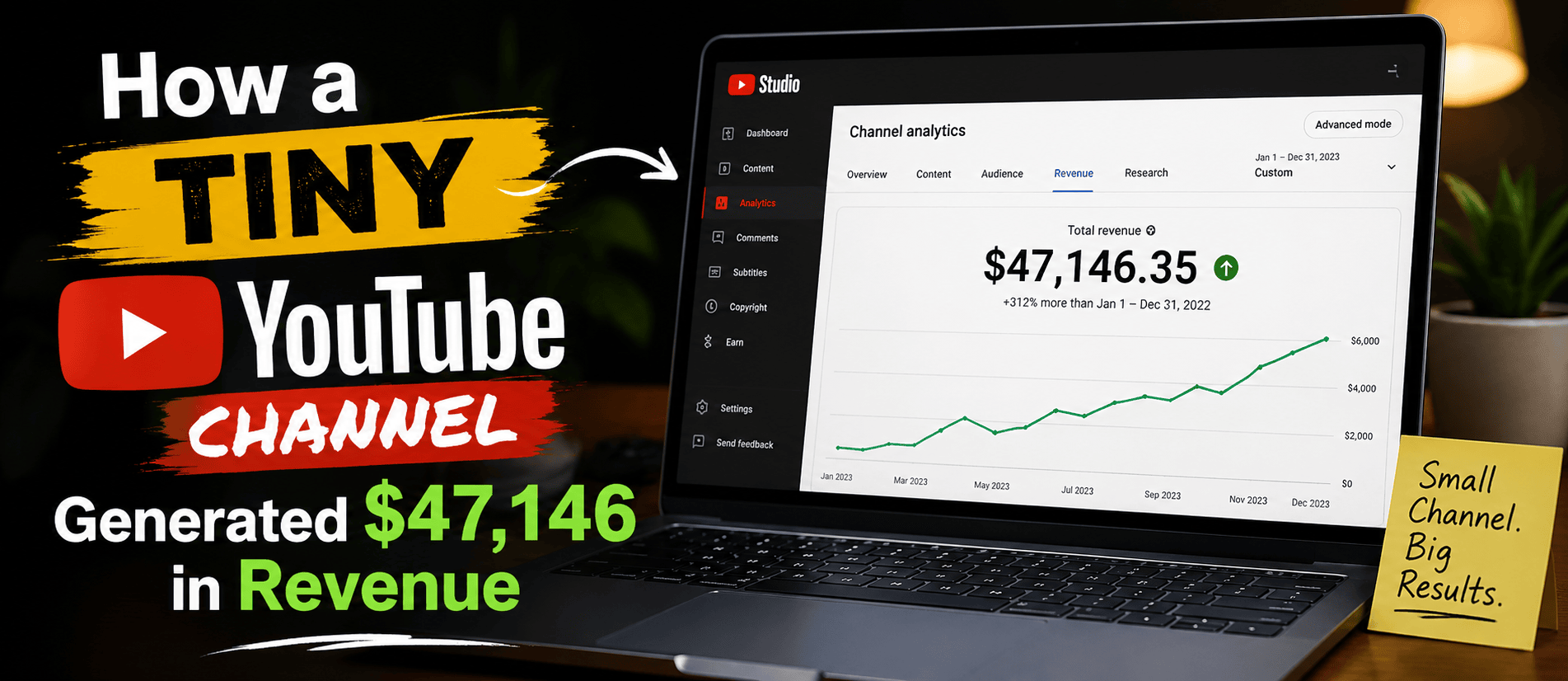
I built a channel in a niche corner of the internet. 7,000 subscribers. Not viral. Not trending. And it generated $47,146, 1,600 leads, and closed contracts I never would have seen otherwise.
If you're sitting on a skill or expertise and wondering whether YouTube is worth your time, this is the breakdown you've been looking for: what actually happened, how the money came in, and what I'd do differently today.
If you want the video version of this post, check it out here:
Quick Takeaways
- A 7,000-subscriber channel generated $47,146 and 1,600 leads: a 22% lead rate most paid ad campaigns can't touch
- The channel is not the business. The channel is proof of competence
- Content strategy: every video targets a specific problem your ideal client is already searching for
- Video collapses the trust timeline. What normally takes months of networking happens in an afternoon of watching
- The real money wasn't courses. It was inbound contracts from people who'd already decided they wanted to work with you
- Build an email list from day one. YouTube's algorithm can change overnight. Your list can't be taken away
The Channel Is Not the Business
Before anything else, this distinction needs to be clear: the channel is not the business. The channel is the proof.
When I started, I was a senior web developer. I wasn't trying to become a YouTuber. I was trying to get more clients and sell a course I'd already built. YouTube was the most efficient way I could think of to put my expertise in front of people who actually needed it.
That framing changes everything. Because the type of channel I built doesn't depend on a huge subscriber count or viral moments. The strategy isn't to get views. The strategy is to create trust.
I had a skill. I built an audience of people who valued that skill and wanted to learn it. The channel did the trust-building for me, 24 hours a day, on autopilot, while I was busy doing client work.
That's the whole model.
The Content Strategy That Brings in Buyers, Not Just Viewers
One of the traps I fell into early on, before I ever started YouTube, was making content for people at the same level as me.
That strategy doesn't help you get clients. It doesn't help you sell anything.
Every video I made instead was aimed at one person: someone who needed what I did, but couldn't do it themselves yet. Beginners who wanted to learn. Business owners trying to understand the space before hiring someone. People with a specific problem, actively looking for a solution.
The topics weren't random either. I thought about what someone types into Google or YouTube when they're stuck. Specific, problem-first searches. Not "what is web development" but "how to do X" or "best Y in 2024." That's buyer intent. That's the difference between attracting an audience and attracting a pipeline.
And because every video was teaching something genuinely useful, by the time someone finished watching, they weren't just informed. They trusted me. They'd seen me think through problems. They'd seen how I worked. So when they hit a wall they couldn't solve themselves, or needed someone to build something for them, I was already the obvious choice.
The content strategy in one sentence: be useful to the exact person who would eventually pay you.
The Numbers Breakdown
Here's where most people are surprised.
$14,000 came from courses. That's the part that's easy to point to: a product, a price, a transaction. But it's actually the smallest part of the story.
The rest came from contracts. Client work that came directly from people who had watched my videos, decided they trusted me, and reached out ready to work. No cold outreach. No pitch decks. No "just following up" emails. They came to me.
And because they'd already spent hours watching me work through problems, the sales cycle was almost non-existent. There was nothing to overcome. The trust was already built.
The Lead Rate That Changes the Math
1,600 leads from a 7,000-subscriber channel. That's a 22% lead rate.
Most paid ad campaigns would be thrilled with that number. The difference is intent. These weren't people who got served an ad while they were trying to watch something else. They came looking. They found me. They watched. Then they raised their hand.
So when you look at the $47,146 total, the real question isn't "how do you make money on YouTube." The real question is: what would your business look like if 1,600 qualified people already trusted you before your first conversation?
That's what the channel actually built. Not an audience. A pipeline.
Why Video Builds Trust Faster Than Anything Else
Think about what happens in a typical sales conversation. You spend the first half of the call establishing credibility. Explaining who you are, what you've done, why you're the right person for the job. You're fighting for trust in real time against someone who has no reason to give it to you yet.
But if someone spends a few hours watching your face and hearing your thoughts on a specific topic, you become an authority figure in their world. The video format creates what some people call a parasocial relationship, where the person watching feels like they know you. The same dynamic that makes music fans feel connected to artists they've never met.
A typical email I'd receive looked like this: "I'm running an AI automation business and we're trying to do XYZ, can you help us figure out how?"
That's not a sales call. That's an order.
YouTube doesn't just build an audience. It collapses the trust timeline. What would normally take months of networking, referrals, and back-and-forth emails gets compressed into however long someone spends watching your videos. For some people that's an afternoon. And at the end of that afternoon, they trust you more than they trust someone they've met at three industry events.
That's what makes it such a powerful sales asset. Not the view count. The depth of trust it builds at scale, completely passively, while you're doing everything else that running a business requires.
What I'd Do Differently Today
Honestly, quite a bit. But probably not what you'd expect.
I wouldn't change the content strategy. Problem-first topics, beginner-focused videos, buyer intent approach. That all still works exactly the same way today. The fundamentals haven't moved.
What I'd change is the offer and the funnel.
Build a Productized Service
I'd create a productized service that makes fulfillment predictable: fixed scope, fixed price, clear outcome. When a channel is sending you inbound leads, you need to be able to handle that demand without it creating a bottleneck. A productized offer lets you scale delivery without scaling complexity.
Start an Email List on Day One
This is the one I feel most strongly about. The channel drives traffic to a landing page you own. Every lead that comes in through the channel should go straight into a sequence that nurtures, educates, and builds on the trust the videos already started.
YouTube can change its algorithm tomorrow and your distribution disappears overnight. An email list is yours. It can't be taken away.
Start Sooner
The compounding effect is real. Videos I made in year one were still bringing in leads in year three. Every piece of content you publish is a permanent asset working for you in the background.
The best time to start was two years ago. The second best time is now.
Who This Model Is Actually For
This model works if you have a real skill and a clear offer. A consultant, an agency owner, a founder who's built something genuinely useful. If you know something that your ideal client needs to know, and you have a way to monetize that knowledge through services, a productized offer, or a course, YouTube can become the most powerful lead generation channel you've ever had.
It doesn't work if you have nothing to sell yet. And it definitely doesn't work if you're expecting results in 30 days.
The first few months are slow. You'll publish videos that get 40 views. You'll question whether any of this is worth it. And then something shifts. A video picks up, a lead comes in from someone who watched three hours of your content and already decided they want to work with you, and you start to see how the whole thing fits together.
What to Do Next
If you're a founder or B2B business owner who wants to build a YouTube-based acquisition system, the content strategy is here. Find a topic your ideal client is already searching for. Make something genuinely useful. Hit record.
Every video you make today is still working for you three years from now.
And if you'd rather not spend the next year figuring out the content strategy, the funnel, and the production side on your own, that's exactly what we help with: YouTube-based acquisition systems designed to generate inbound leads for founders and B2B business owners. Not vanity metrics or viral moments. A steady stream of qualified people who already trust you before they ever book a call.
Get in touch if you want to know what that looks like for your specific business.