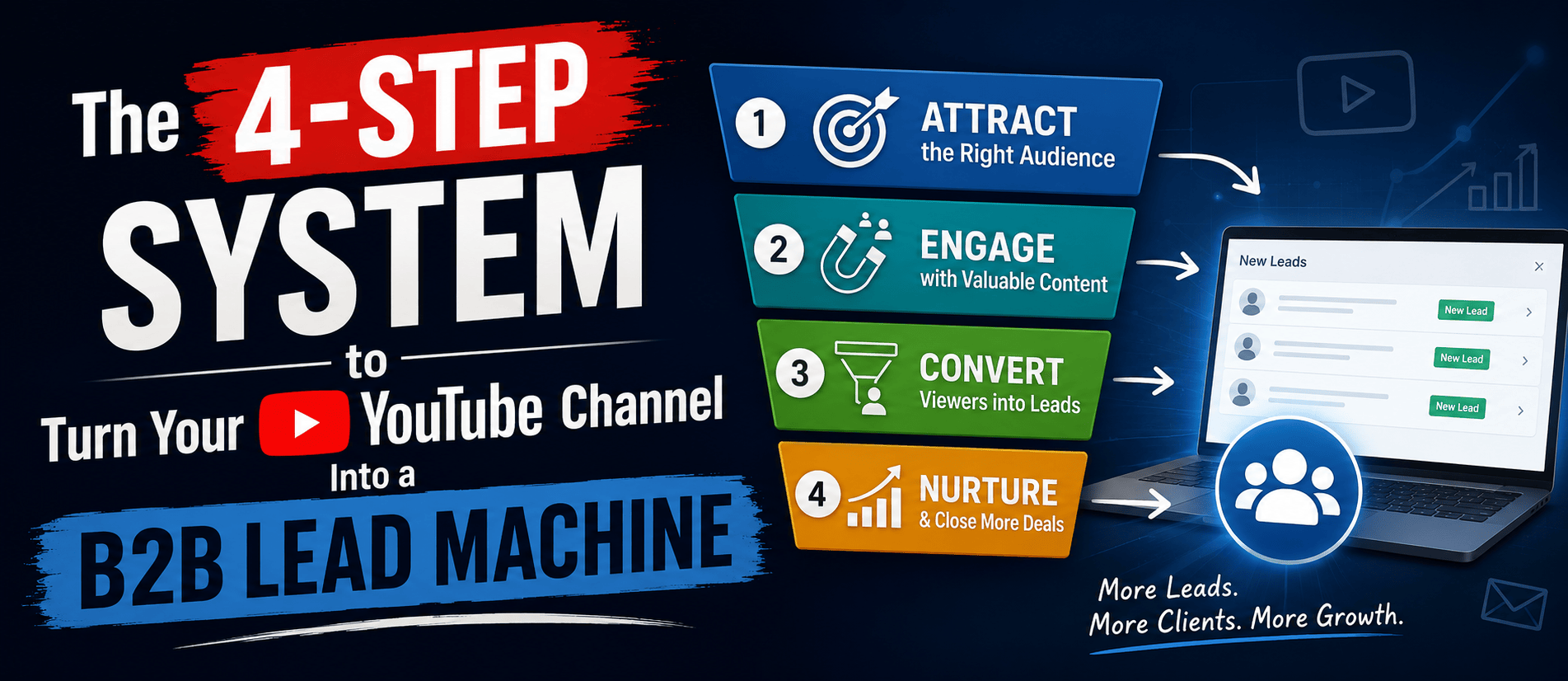
If you're running a B2B business and you're not using YouTube to generate leads, you're leaving money on the table.
Not because YouTube is magic. Because it's the only channel where a piece of content you made six months ago can still be pulling in qualified leads today.
I used a four-step system to generate over $47k from a channel with less than 3,000 subscribers. This isn't about going viral. It's about building a compounding asset that generates qualified inbound leads on autopilot and makes everything else you're doing, like ads and cold outreach, work harder.
Here's the exact system.
If you want the video version of this post, check it out here:
Quick Takeaways
- Four videos a month, targeting problems your ideal clients are already searching for, compounds faster than most paid channels
- Interactive AI-powered tools outperform PDFs and checklists as lead magnets because they deliver personalized value instantly
- Your landing page has one job: convert a curious viewer into a lead. One offer, one action, no distractions
- The system compounds: videos keep working after you publish, your landing page converts around the clock, your email sequence nurtures leads while you sleep
- You don't need a big audience. You need the right audience
Step 1: Publish 4 Videos Per Month
Going viral won't get you clients. Showing up consistently for the right people will.
YouTube is a search engine. Every video you publish is a new piece of real estate, a new entry point for a potential client to find you. The more consistent you are, the more the algorithm rewards you, and the more surface area you have to capture demand.
Four videos a month. That's the target.
I know what you're thinking: "I don't have time for that." And you're right, if you try to do it the way most creators do. Spending days scripting, fumbling through recording, hacking together an edit at midnight.
That's not sustainable. And it's not necessary.
Build a Production System, Not a Creative Process
The right approach is a production system that requires the least amount of your time possible:
- Use AI for scripting
- Build SOPs for editing
- Batch your recordings
- Follow a repeatable structure
All of these small things compound. The result is you spend less time, produce more content, and never sacrifice quality.
You're not trying to make art. You're trying to build a pipeline.
Pick Topics Your Ideal Clients Are Already Searching For
Answer the questions they're Googling at 11pm. Speak directly to the problems they're already trying to solve, and position your offer as the obvious next step.
Done is better than perfect. A video that's 80% as good as you'd like, published this week, beats a perfect video that ships next month.
Step 2: Create a Valuable Interactive Lead Magnet
A YouTube channel with no lead magnet is just a content library. People watch, maybe they enjoy it, and then they leave. You never hear from them again.
That's what a lead magnet fixes. But not just any lead magnet.
Forget PDFs and checklists.
When's the last time you actually read one of those? Your viewers have a faster way to get that information: they can ask an AI for a personalized version of your checklist in 30 seconds, without giving anyone their email.
What Actually Works Now
Interactive tools that use AI to solve one small, specific, and personalized problem for your audience.
The key word is personalized. The tool should deliver value without asking for anything in return, not even an email, until the person has already seen what it can do for them.
That's the shift you're going for.
And this lead magnet needs to be directly tied to your content:
- If your videos are about B2B lead generation, maybe it's a tool that helps your audience define their ICP or build a targeted lead list
- If your videos are about AI automation, maybe it generates a custom workflow based on their inputs
- If your videos are about conversion rate optimization, maybe it audits a landing page and returns a personalized report
The tighter the connection between your content and your lead magnet, the better. It attracts the right people: the ones your product or service can actually help.
You only need one. Build one great lead magnet, use it across all your videos, and let it do the work.
Step 3: Build a Focused Landing Page
You can have great content and a great offer and still lose the lead because your landing page does too much, says too little, or just confuses people into clicking away.
Your landing page has one job: convert a curious viewer into a lead.
It needs to continue the conversation your content started. The prospect has watched, they're interested, they want the thing. Don't lose them here with a confusing page or a weak headline.
What the Page Needs
Depending on what you sell and at what price point, that might mean a tight headline and three bullet points, or a full-blown sales page. But the principle is always the same: one offer, one action, no distractions.
- Put the link in the video description
- Mention it on screen
- Say it out loud in the video
Don't assume people will go looking for it. Tell them exactly where to go and why.
The Hidden Benefit
A dedicated landing page also gives you something most people overlook: a performance baseline. You can track it, test it, and improve it over time. Every percentage point improvement in conversion rate compounds across every video you've ever made.
Once someone opts in, they're no longer just a viewer. They're a lead. And now you have permission to follow up.
If you're not sure how to improve your landing page's conversion rate, I built a free landing page analyzer tool that gives you a personalized report even if you're not a copywriting expert.
Step 4: Convert Leads with a Follow-Up Sequence
Getting someone's email is easy. Knowing whether they're actually worth your time, and converting them into a booked call, is where most people drop the ball.
This is where the system pulls ahead.
You're Capturing Context, Not Just Contacts
When someone watches your video, clicks your link, and uses your interactive lead magnet, they've already told you who they are. Because the tool asked them. Team size, budget, use case, purchase readiness: whatever's relevant to your offer.
You're not just capturing an email. You're capturing context. And that changes everything.
The Follow-Up Sequence
A simple email flow, three to five emails over the first week, that:
- Uses the data you've collected from the lead magnet
- Reinforces your authority
- Addresses common objections
- Invites them to take the next step
No "just checking in." No generic newsletters. Every email is relevant to their specific situation because you already know who they are.
Why This System Compounds
Every video you publish keeps working after you hit upload. A video you made six months ago is still pulling in leads today. Your landing page is converting around the clock. Your email sequence is nurturing leads while you sleep.
It's not a campaign you keep paying for. It's not outreach you keep sending. It's an asset. And every month you stay consistent, it gets more valuable.
The Complete System
To recap the four steps:
- Publish four videos per month targeting the exact problems your ideal clients are already searching for
- Create one interactive lead magnet tied directly to your content that gives viewers personalized value in exchange for their contact info
- Build a focused landing page with one offer and one action, and promote it explicitly in every video
- Run a follow-up sequence that uses the context your lead magnet collected to convert warm, pre-qualified leads into booked calls
That's the system. It's not complicated. But it does require consistency and execution.
The businesses that implement this have a compounding advantage over everyone still chasing views or running spray-and-pray outreach campaigns. Every month they stay consistent, the gap widens.
If you want this entire system built and run for you, content, lead magnet, landing page, and follow-up, get in touch and let's talk about what that looks like for your business.